
Intrepid Finance. Restored Ecosystems.
Vulnerability Reduction Exchange
A visionary, new market to enable decentralised, efficient and affordable climate adaption worldwide.
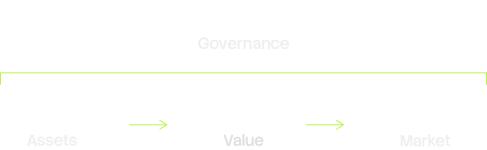
The VRE proposes a blockchain‑based economic ecosystem that monetises climate‑change-adaptation outcomes.
By issuing Vulnerability Reduction Coins (VRCs)—each representing €50 of verified vulnerability reduction—and coupling them with non‑fungible‑token (NFT) assets, the platform creates a transparent, tradable, and incentive‑aligned market for climate‑resilient investments.
Governance is delegated to Vulnerability Exchange Stakeholder Tokens (VESTs), which confer voting rights and act as a credit‑issuing layer.
The VRE aims to attract private capital, charitable donations, and speculative interest while ensuring that funds flow directly to projects that demonstrably lower community exposure to climate hazards.
Impact VRCs Market Funding
Problem
Fragmented climate‑adaptation financing
Projects rely on ad‑hoc grants, limited public budgets, or opaque private deals.
No tradable, verifiable impact assets
Investors cannot easily buy, sell, or price climate‑resilience outcomes.
Governance opacity
Centralised climate‑finance platforms are vulnerable to capture and lack transparent decision‑making.
Liquidity gap
Charitable contributions are illiquid; capital cannot be redeployed efficiently.
Solution
The VRE Platform
- 01
Tokenised impact economy
Issue Vulnerability Reduction Coins (VRCs), each representing €50 of independently verified vulnerability reduction.
- 02
NFT‑backed assets
Physical or project‑level climate‑resilience assets are minted as NFTs; only approved NFTs can generate VRCs.
- 03
Decentralised governance
VEST (Vulnerability Exchange Stakeholder Tokens) give holders voting rights, fee shares, and credit‑issuing capacity.
- 04
Transparent ledger
All token flows, NFT provenance, and proposal logs are immutable on‑chain, audited by third parties.
- 05
Liquidity provision
VRCs listed on DEXs/CEXs, burn‑to‑BTC/ETH bridge, and stable‑coin pairing for price stability
Core Blockchain Architecture and Tokenomics

The blockchain architecture under consideration is a permission-public-hybrid blockchain and, in the first phase, based on the Ethereum blockchain. It will employ smart contracts for governance and ERC-20 tokens as VRCs, minted through nominated proof-of-stake (NPoS).
With growing market share and to reduce costs, we will shift towards a Layer-2 blockchain on top of Ethereum.
In the long-term, the VRE shall be based on its own, proprietary blockchain.
Tokonomics Snapshot
VRC
Impact‑backed utility token
- Minted 1 VRC per €50 verified reduction
- Burned on BTC/ETH swap
- 0.2 % transaction fee.
VEST
Governance & fee‑share token
- Distributed 40 % early participants
- 30 % long‑term contributors, 20 % grants, 10 % partners
- Earns 60 % of transaction fees.
NFTs
Asset representation
- Only protocol‑approved NFTs can mint VRCs
- burned on resale
- Re‑minted for transformed assets.
From Risks to Rewards
The Vulnerability Reduction Exchange offers a novel, token‑driven mechanism to align financial incentives with measurable climate‑adaptation outcomes. By embedding impact verification into the minting process, providing tradable liquidity through VRCs, and delegating protocol stewardship to VEST holders, the VRE creates a self‑reinforcing loop: more verified reductions → more VRCs → higher market activity → greater funding for further reductions.
We estimate the potential addressable market for the VRE to be in the order of 5 to 15 billion EUR, assuming VRCs capture 3-5% of the broader, tokenised impact market.
Successful deployment hinges on robust verification frameworks, regulatory alignment, and active community governance. If these pillars are secured, the VRE could become a cornerstone of global climate‑finance, unlocking private capital for the most vulnerable communities while delivering transparent, tradable proof of impact.